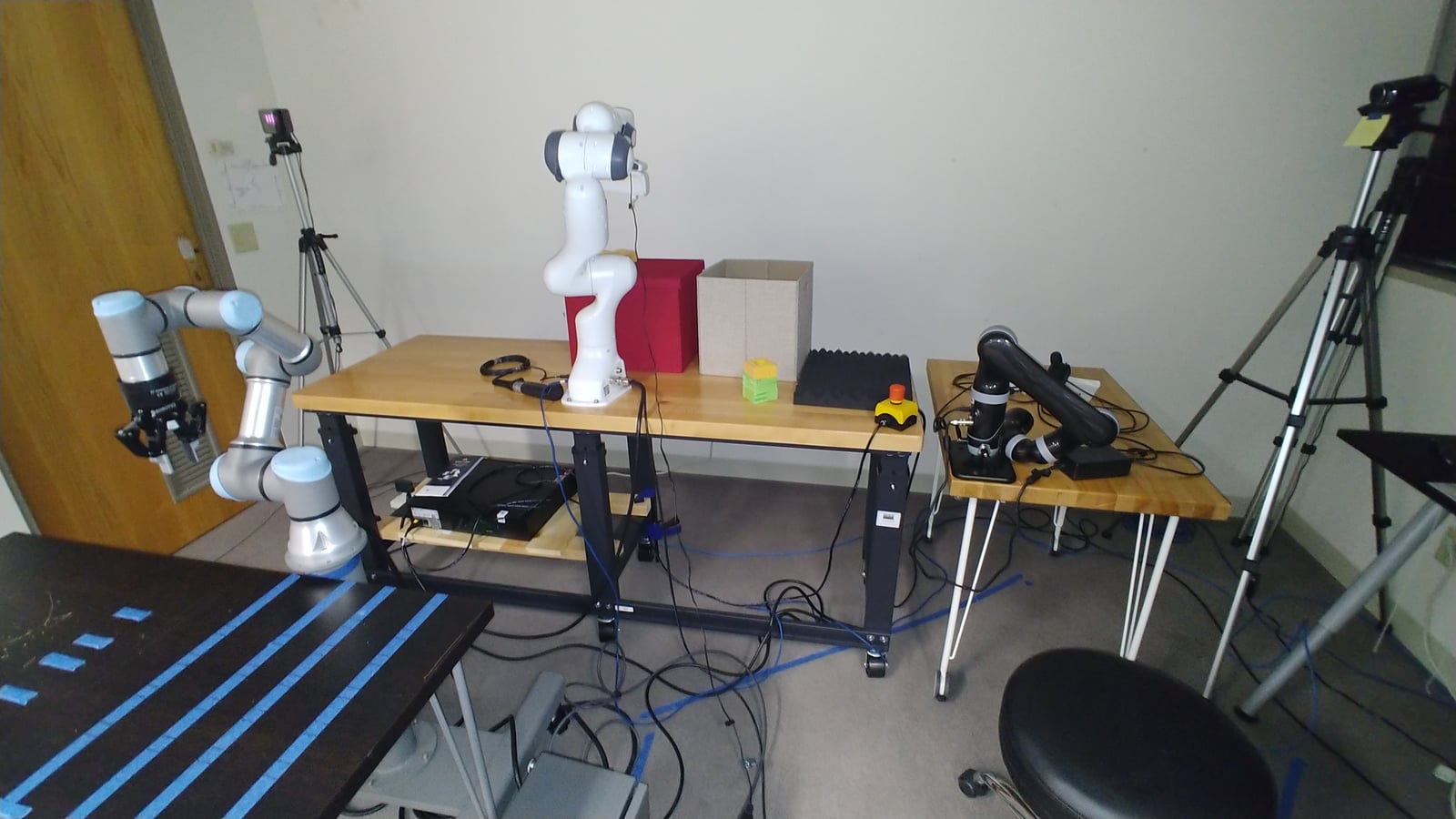
Lab experiment room with multiple robot arms (UR3e, Franka Emika Panda, Kinova Mico).
Lab experiment room with multiple robot arms (UR3e, Franka Emika Panda, Kinova Mico).

Graduate Research & Teaching Assistant
I spent my graduate research at the University of Wisconsin-Madison in the People and Robots Lab, studying how people and collaborative robots actually work together on the factory floor. Most of my work was building the robot user interfaces and experiment systems that let us ask those questions, and then running the studies around them.
A lot of the lab's work traced back to one piece of groundwork: an ethnography of cobots in industry, where we interviewed the managers, engineers, operators, and instructors who live with these systems. An epistemic network analysis of those interviews surfaced the concepts that mattered to practitioners, and those concepts seeded most of what I worked on.
The Projects
My projects were each a different angle on the same question: how do you make a human-robot team work well. Authr was an authoring environment for splitting a task between a human and a robot. CoFrame was a training environment that coaches novice operators toward expert-quality cobot programs. Task Interdependence and pRAD were paired studies on how a cobot's demands on the operator shape the work, and how to communicate them. Each has a fuller writeup in the Notable Projects section.
ONET
When the COVID lockdown made in-person human studies hard to run, we leaned on existing data instead. Working with colleagues in Human Factors and Optimization, we used the O*NET catalog of work activities as a test bed for studying where collaborative robots actually add value across manual work. My piece was rating collaborative-robot capability for each activity, using a decision flowchart a colleague and I built and grounding it in a sizable literature review of cobots at the current state of industry. Those ratings fed the allocation algorithm at the heart of the study, which was published in Human Factors.
Lab Duties
Beyond the formal projects, I did a fair amount to keep the lab running. I maintained a centralized robot description and configuration repository, wrote documentation and bringup code for our Universal Robots UR3e and Microsoft Hololens, and developed and patched the Robotiq gripper ROS driver for our setups (including serial-tunnel support on the UR3e). It was also just expected that you would help colleagues with their user studies, technical development, and paper writing, which I did often.
Teaching
My first semester of graduate school (fall 2018) I was a teaching assistant for COMPSCI 506: Software Engineering, taught by Dr. Tracy Lewis-Williams. I mentored a subset of the project teams through the full engineering process: finding an external stakeholder and project, gathering requirements, writing user stories, implementing a prototype solution, and presenting at demo day. Beyond the teams, I graded, held office hours to explain concepts, and gave the lectures on version control.