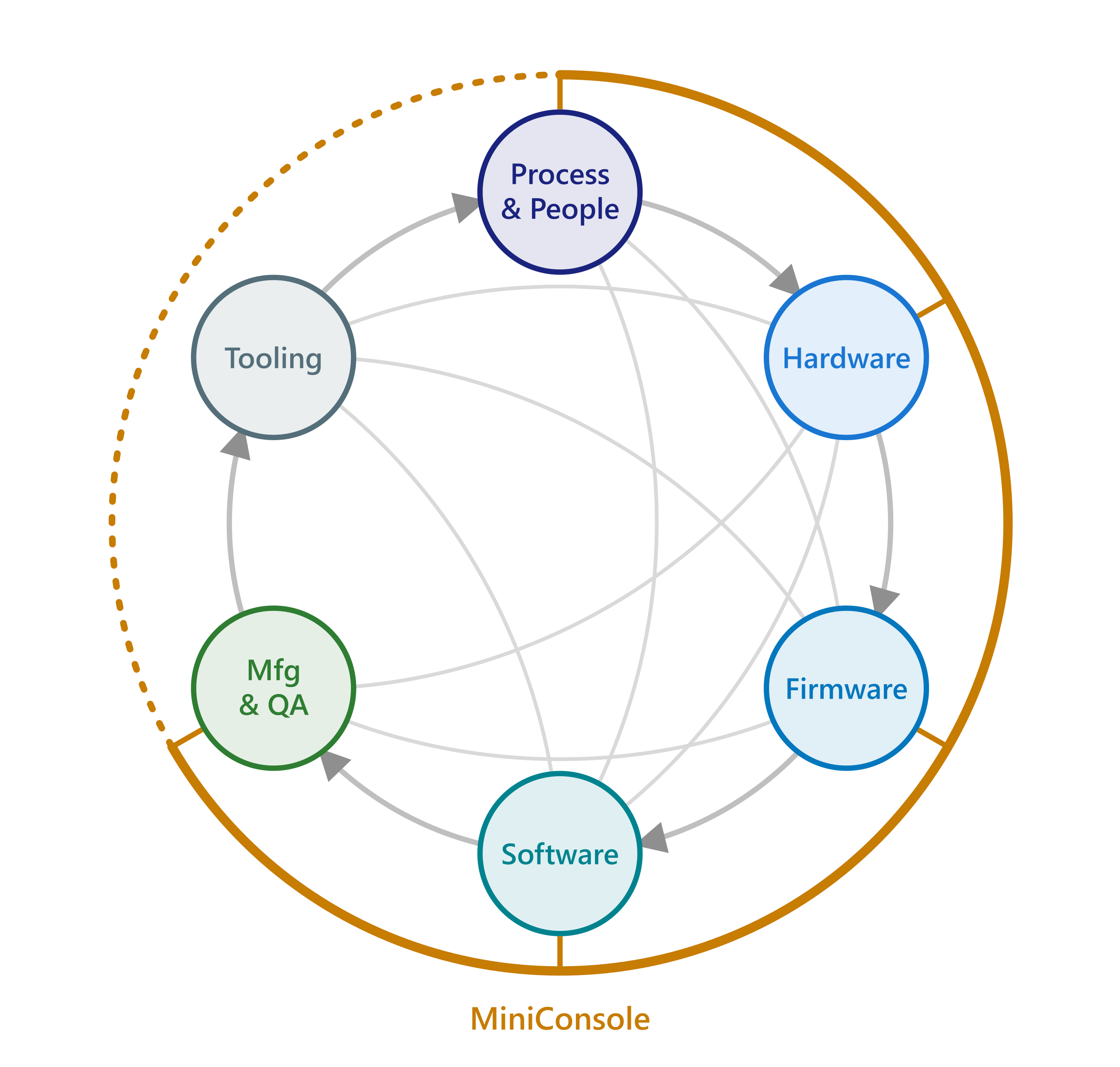
How each part of my work at IDES feeds the next.
How each part of my work at IDES feeds the next.

IDES, Inc.
IDES is a JEOL group subsidiary working in the transmission electron microscope (TEM) market. IDES develops the Relativity sub-framing system, the Electrostatic Dose Modulator (EDM), and various other TEM peripherals to support scientific applications.
Firmware Engineer
As the primary firmware engineer at IDES, I focused on maintaining and extending existing firmware, developing new voltage control firmware for the movie mode (MM) deflector on our flagship JEM-2100 Time-resolved TEM, and performing hardware bringups. Our firmware ecosystem is mixed C/C++ across Xilinx Zynq SoC and Atmel/Microchip platforms. Additionally, I prepared embedded Linux system images for production of our Acuity Edge computer vision platform.
Working at a small company, I also took on responsibilities outside of my core firmware role including electronics manufacturing, ECAD support, PCBA procurement, and developing user-facing Python software for hardware interfacing.
I was promoted to senior engineer.
Senior Embedded Systems Engineer
As senior engineer, I continued supporting existing hardware/firmware shipped to customers, including working with our parent company to diagnose and test systems internationally.
Process & People
Before anything gets built, I gather requirements and write specs, work toward consensus on what we are building, and run user experience testing with the people who will use it. I also mentor engineers and help hire and train our manufacturing and software staff.
Hardware
Board design
I led component selection for next-generation products, evaluating microcontrollers, ethernet controllers, and I2C devices with a focus on maintainability and supply-chain resilience.
FPGA / SoC
My largest FPGA / SoC project was extending our Xilinx platform to support multiple SoC variants while maintaining a unified codebase. This involved building out a development process for multiple Vivado projects with shared Verilog HDL and a unified C/C++ system supporting multi-core Vitis projects.
I also implemented an AXI DMA transfer pipeline that improved memory throughput by 10x for a key application.
Firmware
I developed a SCPI-based voltage instrument control service.
I also led the transition from a bare-metal round-robin architecture to FreeRTOS, using dual cores to enable onboard application-specific acceleration. This included spinning up a REST API and embedded web dashboard built on FreeRTOS+TCP.
Software
Backend
I led a major refactor of our hardware control backend, replacing a tightly coupled architecture with a decoupled PubSub-based system (drawing on my experience with ROS). I built out a layered testing strategy spanning driver-level unit/integration tests through system-level QoS validation. I also mentored an intern who prototyped the new REST API layer.
Vision
My current focus is real-time GPU image processing for high-speed detectors in 4D-STEM. The work covers pipeline development and integration with our existing hardware control ecosystem.
Manufacturing & QA
I trained manufacturing engineers in electronics assembly processes and provided ongoing QA support. I authored extensive build documentation, standardized packing procedures, and maintained our MRP system. Over time I was able to step back from active work in this area to a minor supporting role.
Tooling
My role has expanded to include AI-augmented development workflows for firmware and software tasks. I work daily with agentic coding tools, both Claude Code and Gemini CLI, choosing between them based on their aptitude for the task at hand. These tools assist with debugging, code generation, and maintenance across our embedded and application-level codebases.
To bring these tools into our engineering process safely, I developed an agentic-first, MCP-based CI system. It gives coding agents a controlled interface to trigger builds, run benchmarks, and deploy against our hardware resources without putting the equipment at risk.
I also built an internal hardware test bench for the EDM. We use it heavily for firmware and software QA, and at times for manufacturing QA and RMA diagnosis. It is not connected to the MCP tooling yet.
MiniConsole
I designed and developed MiniConsole, a USB user-interface peripheral featuring integrated OLED displays, a tactile encoder, and haptic/audio feedback. I took this product from requirements analysis through schematic capture in Altium, board bringup, firmware development, mechanical enclosure design, custom Windows driver development, Python interface development, integration into the existing software ecosystem, CE marking, and productization.